
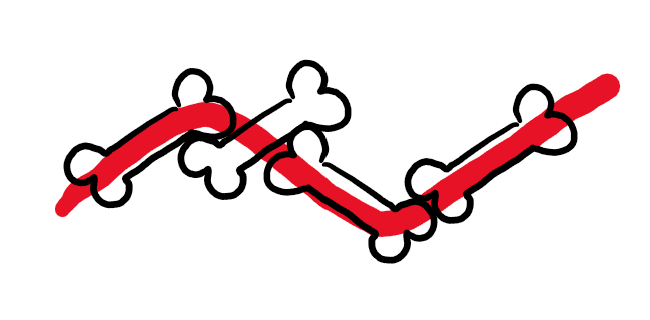
In this essay I will propose how we can create an open-source Latin curriculum, which I nickname the Medulla, or the bone-marrow. This curriculum can serve as the common core for a diverse new generation of Latin textbooks.
Have you ever daydreamed about writing your own Latin textbook from start to finish, knowing deep down that seriously, it would take far too much work to create and you’re not even sure where to start or if you would be able to finish it at all, let alone do as good a job as a big institution like the University of Cambridge?
I’ve indulged in that fantasy quite a lot over the years. I’m sure every Latin teacher has. I’ve probably started and stopped planning about three Latin textbooks and a Greek textbook, and so far I’m glad that all these projects have died in the ideation stage. But the desire remains.
And that desire keeps coming back as I realise that I have built years and years of my current curriculum materials around a sinking ship: the Oxford Latin Course.
Let me tell you about my predicament, and you tell me if it resonates with your experience.
Every year I am using the OLC is another year closer to the OLC becoming unusable by my students. The course was first published in 1987 with a substantially revised second edition published in 1996. There has been no further publishing activity since the 90s, so the textbook I am teaching from is now more than thirty years old.
Worse than that, it is now officially going out of print, with only a few booksellers stocking dwindling copies worldwide. Soon there will be no place it can be purchased, except in limited copies as used books. The global supply of OLC textbooks is non-renewable and diminishing every year.
However, the series is not out of copyright, and it will not be out of copyright until some 70 years after the death of Maurice Balme in 2012 – so I could start printing copies of it in 2082! If I am still alive at that time, I will be ninety years old.
I have been creating stories, interactive multimedia grammar tools, tests, exams, videos, and all manner of curriculum planning documents for this Hindenburg of a textbook since I started teaching with it in 2018 some seven years ago. I remember being given the option of switching the whole school over to the Cambridge Latin Course in 2018 but a colleague, who knew very little Latin, and who had learned to teach with the OLC just one year prior by keeping a few chapters ahead of the students, begged me not to switch to the CLC or he would have to relearn everything. He left the school maybe a year or so after, but by then I had sunk enough resources into remediating the OLC that I was now unwilling to move from it myself.
Now, seven years later, with the course going out of print, the school is pressuring me to move away from the OLC because of sourcing concerns. I’ve patched this course so much that my curriculum is pretty much more patch than cloth. I’m going to have to throw away the last seven years of my work and start from scratch with a new textbook, unless I can convince the school that the big class sets of library copies will be enough to keep the students resourced for the foreseeable future. It’s in a negotiation stage right now, and at any time in the future if those library copies start to go missing and supplies dwindle, we’re going to have this conversation again.
The purpose of this preamble is to present one of the practical problems of teaching Latin from the current model of textbooks. Latin, along with Classics and the Humanities in general, is contracting in higher education. There are fewer university-based institutions that have the resources to publish and maintain our existing textbooks. Unlike some modern languages, Latin does not get a whole set of newly minted products every year. We are forced to use aging textbooks because these are the only things available, other than what we make ourselves with our limited time and resources. You had better pray that your textbook continues to stay in print or you will have to throw out years of your work and make a big, wasteful switch to another textbook.
I’m sure every Latin teacher has gripes about the textbook they are using. There is no way that any single textbook can please everyone, but at least they substantially reduce the amount of work we would have to do if we wrote entire textbooks ourselves. The solution for most teachers is to stick with a course and create supplementary materials to customise it to your teaching style and your students’ needs.
But every textbook is a ticking time bomb. Every single one is copyrighted. I can almost guarantee that your textbook is already more than twenty years old, and that it will go out of print decades before its copyright expires. Some series are more active than others, but as the Classics in universities continue to contract, institutional support for aging textbook series is getting worn down thinner every year.
Enter my proposal: the open Latin textbook framework, the Medulla.
Currently every textbook contains its own unique sequence of core vocabulary and grammar. It is a closed system and any resources built around one textbook are only compatible within that one series.
What if we – that is, I and whoever wishes to form a working group with me for this task – created a core sequence of grammar and highly frequent vocabulary? We research Latin curricula around the world with the goal of creating a sequence that is compatible with as many school systems as reasonably achievable. We create the underlying structure, prioritising a sequence that allows for flexibility of implementation. We then release this core sequence as an open-source document.
Then, if the core sequence of our Medulla is well received by the global Latin teaching community, individuals and institutions can without restriction flesh this out into their own proprietary courses (or open source courses, if they have the funds to do so) that are nevertheless mutually compatible with each other because they all share the same open-source starting point.
There are multiple advantages to reducing barriers to entry and exit from textbook courses, advantages that go far beyond just mitigating the risks of books going out of print. I will show below how an open Latin curriculum such as the Medulla could allow teachers to experiment with different pedagogical approaches relatively risk-free, allow for student choice of themed units, allow for different teacher choices of textbooks within the same school, allow smoother transitions between turnover of staff at schools, and how this concept could greatly reduce the amount of duplicate work we are already doing as teachers.
Closed Textbooks, Untextbooking, and the Open Textbook
Let us outline the alternatives to my proposal: namely, to continue using copyrighted, closed system textbooks; to use public domain textbooks from 100 years ago; or to create a custom curriculum from scratch using novellas and teacher-created resources as in the Untextbooking movement.
At the moment, public domain textbooks from 100 years ago are very clunky to use in class. They often contain awkward political statements that have aged poorly, or simply do not provide enough input. I wish there were more recent public domain textbooks with more updated methods that were suitable for classroom use. But as it is currently, the best quality resources available to Latin teachers are proprietary textbooks. In the sections below I will discuss the limitations of both using and avoiding the use of our existing copyrighted textbooks.
Closed textbooks
Closed textbooks include proprietary courses such as the Cambridge Latin Course, the Oxford Latin Course, Ecce Romani, Lingua Latina Per Se Illustrata: Familia Romana, and newer courses such as Via Latina and Suburani. I also include in this category grammar-translation style courses such as Wheelock’s Latin and So You Really Want To Learn Latin.
I have observed that often in schools, one Latin teacher is very determined to teach in a particular way while the other is determined to teach in the exact opposite way, and they have to marry their curricula together somehow. One teacher will insist on Wheelock’s Latin, for example, while the other will insist on Familia Romana. Or in my experience, the early years were spent in a mixture of So You Really Want To Learn Latin and Ecce Romani while the later year levels picked up from the Oxford Latin Course.
Or often there will be just one main Latin teacher in the school who retires or goes on maternity leave. The school then struggles to secure a permanent Latin teacher and hires a series of short-term replacements. Each replacement Latin teacher introduces a textbook change and erases the curriculum left by the previous teacher. The poor students switch courses, often multiple times, before a permanent Latin teacher finally gets them onto one course and stabilises the ship. (God forbid that teacher ever retires, moves interstate, or gets pregnant!)
It is very difficult to choose between textbooks when there are high points and low points in each. For example, I like how the OLCincludes myths from the Trojan Wars, and recounts historical events from the murder of Julius Caesar to the rise of Augustus. But I dislike most of the other stories in the textbook. Similarly, there are teachers who love the stories based on the eruption of Vesuvius in Pompeii in the first book of the CLC, but find the setting of Roman Britain pretty boring in book two (if you’re not teaching in the UK, the references to UK-based archaeological sites aren’t very relevant to your students). I like many aspects of Familia Romana, but I find the treatment of slavery and corporal punishment by the narrator repulsive. If only, I think to myself, if only I could just take some of the chapters of this book and mix it with the chapters of that book.
Closed textbooks make it very difficult for teachers to try new things. They force you to either commit to one system and stay locked in for years, or to expend a lot of effort and work switching to a whole different ecosystem.
But what about Untextbooking?
Untextbooking
Rachel Ash wrote an article in 2019 entitled, ‘Untextbooking for the CI Latin class: why and how to begin’. In it she describes her process of creating a curriculum without using pre-existing textbooks at all. She outlines how to choose a unit theme, how to select readings by adapting Latin texts on that topic, and how to create focused vocabulary lists based on those readings. The Latin texts could be adapted readings from authentic texts, taken from novellas, or written from scratch based on Roman or non-Roman contexts. The teacher sources, curates, adapts and writes these texts as well as creating all the activities around these texts.
She pulls no punches in describing how demanding this approach is on the teacher’s time.
I will not mislead you into thinking this is easy. It is extremely hard work. It is late nights, assessment, self-assessment, research, and cross-examination of your creations. It is checking your ego at the door because something you poured your heart and soul into, sure your students would love it as much as you do, was met with lukewarm feelings or even sarcasm. Untextbooking is teaching, but with even more of yourself invested into it.
When I read this, I think back to the first time I tried implementing a CI-based approach in 2022. I was passionate about changing everything, doing a root and branch renewal. I almost abandoned the OLC completely, but ended up just heavily supplementing the textbook with stories and CI-based activities that I was trying out for the first time. I used novellas and implemented a regimen of Sustained Silent Reading from those novellas. Everything that I could change, short of totally rewriting the textbook, I did change. I was ‘building the plane while flying in it’. I wanted to see what this would do for my Latin program.
I nearly burnt out that year. It was intense. I had nightmares and insomnia that got worse as the year progressed. I would break down crying if a relative asked me how work was going. I was frightened by loud noises. My ability to implement behaviour management in the class was seriously compromised. I started dreading going to work. I would drive to work and have to convince myself to step out of the car. I had to stay home the first day back after the school holidays, because of an overwhelming sense of panic. I used the services of a professional counsellor. The school relieved me of some of my more stressful classes while I recovered. I chose to change my working hours from full time to 0.8 for the next year to prevent burnout. I was seriously worried I might have to leave teaching altogether.
Thankfully, by drastically restricting the amount of schoolwork I did outside of school hours, and by going down to only four days a week of teaching, I gradually recovered.
Late nights of working around the clock to produce Latin texts that you also create activities for, on top of everything else a school teacher needs to do, are critically unsustainable.
I didn’t even go full Untextbooked and I could have permanently left teaching.
Burnout is not pretty. Teachers should be strongly warned against putting themselves in a position where they may have to work late hours into the night to keep their Latin program afloat. Textbooks are a lifeline because they allow you to go to bed at a reasonable hour, to cook meals, to spend time with your family and to not constantly be doing schoolwork.
I think Latin teachers are a very passionate group, and we love to create our own materials. But completely rewriting a course from scratch by yourself is a huge burden on any individual Latin teacher. That is why most of us use textbooks as a base and make small improvements – it allows us to work on updating our materials in manageable pieces.
I would also add that an Untextbooked curriculum suffers from succession problems. When that highly inspiring Latin teacher leaves the school, it is very likely that the next teacher struggles to understand the radical Untextbooked approach and finds it difficult to continue the sequence of learning where they left off, because there is no set sequence of what the students are supposed to have encountered by now. Every teacher making their own totally unique materials faces the same problem: how does one do a handover of a curriculum customised to yourself, if you need to go on maternity leave or move jobs?
Latin teaching is not just about cutting-edge pedagogy. It’s a profession where, for practical reasons, we need to work with colleagues who might have different approaches.
Both committing to a textbook and committing to going without a textbook are very big commitments. To experiment with new pedagogical approaches, it would be much better if you could just trial a new method for a few chapters and be able to switch back to your first approach if the experiment doesn’t turn out as you hoped it would.
Enter the Open Source Latin Curriculum, the Medulla.

The Open Textbook
Here is what I propose for the Medulla, in more detail.
A working group of teachers from around the world, representing each major curriculum region, collaborate to create a very stripped-down core sequence of grammar and highly frequent vocabulary that will serve as the basis for a new generation of textbooks.
The organising principle of this bone-marrow is to allow for flexibility of what can be made from it.
We decide on an arbitrary number of ‘chapters’: let’s just say 50 chapters for the sake of argument, but it may as well be 38, 54, or 47.
Each chapter is assigned core vocabulary and featured grammar. There is an effort made to spread the load evenly between chapters, so that there aren’t too many big spikes in difficulty.
Vocabulary
The core vocabulary focuses on functional words, not topical vocabulary. For example, any chapter 1 story could contain words like ‘est’ and ‘et’ and ‘in’. But topic-specific words like ‘aqua, fēmina, agricola, īnsula’ for chapter 1 are very restrictive and force people to write about water, women, farmers and islands in that chapter. The intent of a core vocabulary list is to provide common structure to support a diversity of implementation. If someone wants to write a course based on just stories from the Trojan War, they can. If someone wants to write an ecclesiastical Latin course based on bible stories, they can. If someone wants to write historical fiction set in Rome at the time of Cicero, they can. If someone wants their stories to be about a time-travelling school bus, they can.
The core vocabulary could be based on frequency lists such as the DCC top 1,000 words, but it need not include every single word in a list of 1000. The purpose is more to provide a baseline for introducing functional words so that students don’t miss out on them. I have recently taken over a cohort of students who were learning from Ecce Romani and they hadn’t yet encountered a very common word: ‘-que’. The OLC barely ever uses the extremely common word ‘vel’ and hardly ever uses ‘fuit’ or ‘fuērunt’, overusing ‘erat’ and ‘erant’ instead. Many newly written Latin materials present a language shorn of discourse particles such as ‘enim’ and ‘vero’, because of the desire to keep unique word counts as low as possible. Functional words like these are everywhere in authentic Latin texts, and will be important no matter what topic the student wants to eventually read about. Students need lots of exposure to these functional words spread throughout their learning journey.
Grammar
The core grammar sequence provides a guideline for when each major item of grammar is featured.
Anyone intending to create a textbook based on Grammar-Translation or the Reading Method will readily understand the usefulness of a sequence of grammar topics, but what about people aiming to implement a more purist CI approach that eschews grammar sequencing entirely? To them I say, if anyone wants to write a purely CI Latin curriculum that includes all grammar from the beginning, they still can do this and freely include ‘advanced’ grammar in their earlier chapters. They just need to provide feature-worthy examples of the target grammar in the target chapters. That is, they need to allow circumstances for pop-up grammar lessons to occur in the agreed chapters. The sequence of grammar is a guideline that allows for easy entry and exit between courses, and the presence of ‘advanced’ grammar sneakily incorporated in earlier chapters is not a barrier to readers either entering or leaving a course.
The working group needs to include representatives from each region of the globe where Latin is currently taught in high schools. The goal is to create a sequence which is compatible with the largest number of pupils under the current curriculum conditions. The representatives need to research their local curriculum requirements and report what the hard limits are for each schooling region in their care. For example, does your school district require all noun cases to be introduced within a certain amount of time into the course? If there is a small region which is extremely prescriptive, we may need to make a pragmatic decision not to accommodate that curriculum, in order to accommodate more pupils worldwide.
There are known debates about the sequencing of grammar, such as whether to introduce declensions 1-3 together and learn the cases one at a time, or whether to learn all the cases for declension 1 first, then learn declension 2, then declension 3. The guiding principle is still to create a curriculum which is the least restrictive for the most people. For the example mentioned above, introducing all three declensions at the start does not prevent teachers from creating Grammar-Translation textbooks, nor does it prevent teachers from teaching full declension chants from the beginning before all the cases have been met in context. However, withholding declensions 2 and 3 severely restricts the types of stories which can be written in the early chapters to the world of islands, women, farmers, and water. Therefore it should be preferred that all three declensions are introduced early, for the sake of allowing a greater diversity of pedagogical approaches.
It may be objected that some grammar topics (gerundives, for example) are only difficult because they are introduced so late. To this I say, the grammar topic sequence is for dividing up time so that there is enough time to give focused attention to each topic. If gerundives are one of the last things to be officially focused on, they can (and should) still be ‘snuck in’ to earlier chapters and glossed as necessary. A language contains many grammatical topics, and so if there is any spotlighting of grammar at all, some items must have their time in the spotlight later than others. This does not mean they should be saved up to the last possible moment.
Next steps
My proposal is that we form a working group that includes Latin teacher representatives from around the globe. We assign curriculum research tasks and share our findings. We take stock of the curriculum restrictions in various regions. Then we hash out a draft curriculum. We present the draft of the Medulla for feedback and review by Latin teachers worldwide. We make edits to the curriculum. We publish a finished document in the public domain.
Only after the Medulla has been well received does anyone start writing an implementation. Because the structure is public domain, anyone anywhere can develop a textbook based on this structure without restriction.
Advantages for using the Medulla
Institutions can use this structure as a starting point, knowing that it will be compatible with as many regional curricula as possible, meaning they can sell textbooks globally. They can also proceed knowing that the structure has the vote of confidence of the general Latin teacher community.
Circling back to what I said at the beginning, pretty much every Latin teacher has a dream of writing their own course. Now they don’t have to do any duplicate work in the planning stage. You could take your ideas and start writing just a few chapters if you wanted to. If you primarily teach the lower years, you could just create the first 10 chapters and stop. If you primarily teach upper years, you could just create the final 10 chapters. No one has to commit to creating an entire Latin textbook structure from scratch, just to get their ideas on paper.
If anyone wants to create themed units, they can. They don’t need to create an entire Latin textbook to make 5 chapters that focus on Gladiators and Chariot Races. Teachers could allow students to vote for their favourite topics and then create short unit-based resources that just span a few chapters.
If anyone wants to create a course entirely based on tiered readings from authentic texts, they can, and just need to include some feature-worthy examples of the target grammar for each chapter so that each topic is given enough spotlight.
If a school wants a teacher to create their own in-house resources, they can do so in stages, while using another resource for teaching. For example, a teacher could use a proprietary course, but just write 5 chapters of their own per year. After 10 years they’ve written 50 chapters, and little by little the entire course has been replaced.
The work could also be shared between teachers at the same school – one teacher can pick up the task where the other teacher left off. If one teacher leaves the school before finishing writing a textbook, it is obvious what parts they have done and what parts remain.
The approach in general allows easier handover between teachers. If one teacher leaves and a new teacher is hired with different tastes and styles, the next could choose to switch to any number of proprietary courses that run the gamut of Grammar-Translation to CI approaches, without breaking sequence.
If there are two teachers at the same school who have wildly different approaches to teaching Latin, each of them could adopt textbooks that apply different teaching methods to the same framework and students would be able to move from one teacher to the next relatively seamlessly. (This is not the case when a student leaves a course halfway through Familia Romana and moves to Wheelock’s, or vice versa!)
If a teacher wants to try a different pedagogical approach, they can do so for just a few chapters, and know that they can safely switch back to their more familiar style if it doesn’t suit them to continue.
Researchers would be able to make A/B tests of Latin curricula. A cohort of students from the same school could be divided randomly into two groups, each of them studying from a different approach but covering the same material. Through this, it would be easier for us as a profession to learn more about the effectiveness of different pedagogical approaches.
Final encouragements
I am passionate about improving Latin teaching, but the older I get, the more I realise how complex the situation is. As findings from Second Language Acquisition research come to light, what is considered ‘best practice’ today will not necessarily be best practice tomorrow. Meanwhile, within the traditional suite of Latin teaching practices, I am sure that there are hidden gems, kernels of wisdom that are not yet fully understood or appreciated by the younger generation of more CI-minded teachers like myself.
My goal in proposing a Medulla, a deeply rooted bone-marrow at the core of a curriculum, is not to impose change on the unwilling, or to restrict the development of new methods. It is to free all Latin teachers from the unnecessary burdens of duplicate work, of labouring alone in our siloes and making dead-end resources for closed textbook courses that are inevitably going to go out of print.
But I cannot do this alone. I need representatives who know the curricula of their region and are willing to lend their time in research and development of an open framework that allows us to break out from working in just one textbook ecosystem at a time.
Until we do this groundwork, we are bound to continue making closed courses and an endless number of proliferating incompatible systems.
At the current moment, every textbook is its own island.
If we created an open framework and just two decent textbooks came out of this in the next generation, this would be the first example of a pair of complete, mutually-compatible textbooks that teachers could freely move into and out of.
If you believe your expertise can help in this, please contact me via my contact form and I will arrange for a working group for the Medulla curriculum to be formed, and sketch out the tasks and timelines for us.
In your email to me, please include your name and:
- What is your location?
- Is there an official Latin curriculum (or several) in your region that mandates the teaching of grammar or vocabulary at certain stages?
- Tell me a short summary of your experience in teaching Latin, and your general approach to teaching Latin.
I will aim to create a working group that is not too large but still representative of diverse regions and approaches.
I will be collecting expressions of interest for the next month, October 2025. If you can please share this call for help with other Latin teachers, especially in more remote regions of the globe, that will be helpful too.
Curāte ut valeātis.
Carla
 Found in Antiquity
6 responses to “The Medulla: A Proposal to Break Out of Closed Latin Textbooks and Create an Open-Source Curriculum”
I would like to take part.
Rose Williams
Thank you, I’ve emailed you!
Just seeing if my message made it through.
I haven’t got an email from a handyarmurlo. Are you by any chance also “Haywardeaf”? I received a blank email from that first name.
I’m the guy from Connecticut but clearly my internet is glitchy since this comment happened twice. Glad my other email made it.
Ah wonderful, I’m glad we connected in the end. The comments section on my wordpress is slow to show new comments because wordpress holds them in a kind of moderation zone before I can manually approve them to appear. Sometimes people comment multiple times because their comment doesn’t show up, which can be confusing.