
-
Top ten Fayum Portraits
At the moment, I’m in full flurry of editing my Classics Honours thesis which is due on Monday. Enjoy these Fayum mummy portraits while I prep my thesis!
What strikes me about these is the incredible individuality of each of these faces. It’s like the coloured, painted equivalent of looking at Roman statue busts where the artist has lovingly rendered the personal, unconventional features of each person, and even celebrates the defects of the sitter’s face.
-
Rape Culture in Classical Mythology
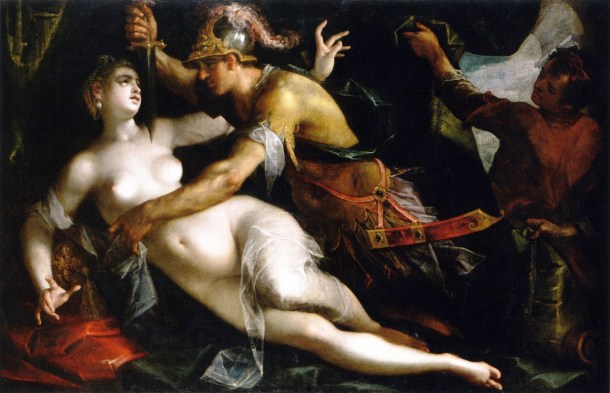
Tarquinius und Lucretia, Hans von Aachen, ca. 1600 I’m a little ambivalent about putting this take-home exam essay I wrote in second year up on the blog. On the one hand, it’s something I’ve thought about posting up for a while. On the other, I feel that even though I’ve learned more about Classics and grown as a person since second year, I still find this essay disturbing in many ways. It’s an answer to the question, “Why did Greek and Roman myths have so much rape in them?” A nasty subject at the best of times. But I’ve weighed up my options, and found two reasons why I feel this was worth posting.
Firstly, there’s a bit of bragging on my part. I’m pretty sure this is one of the highest marked essays I ever wrote in my first three years of undergraduate study. It was graded in the 90’s (whereas any mark over 80 would have put the essay in the top 10%). That didn’t necessarily happen because it was the best essay I wrote, but it was very well received by the university. Feminist essays are satisfying like that. I don’t think there’s any other ideology that the university would be happy to see you jump on your figurative high-horse and lambast your ideological opponents with. Looking back, I wonder if this essay is slightly overdone at times; but your reading of it may vary. Clearly my examiners very much enjoyed it.
The second reason I have for posting it here is that this essay very much resonates with the modern issue of Rape Culture. In the twenty-first century, we’re still consuming so many stories, films and TV series which shove images of violent, pushy, rapey sex in our faces, whenever directors want to make sex look more exciting or the protagonists more virile. I would say that these rapey depictions of sex are cheap thrills in movies, but they’re worse than that. The movies we watch tap into a deeper narrative which justifies a rape as understandable, that it’s the normal way for a man to react to seeing a woman – that woman – the one who takes your fancy, the one who’s dressed just slutty enough, the one who’s supposedly asking for it.
-
When Classics and Theology were the same subject
Classicists are usually vaguely aware that the study of ancient literature is a very, very old field of research, and that it used to be merged with the study and exposition of Christian theology. It is rare, however, for a Classicist to actually come up against past scholarship and see firsthand what kind of work that that unholy (or holy?) union had once produced. More often, modern Classicists are looking uncomfortably at each other, trying to spy latent “Christianizing” approaches in their own work, without actually having a clear definition of what could constitute a “Christianizing” approach in the first place.
-
The five strangest deaths of the philosophers
The greatest philosophers of the ancient world were celebrated not just for their voluminous writings on arcane topics, but also for their eccentric lives and witty sayings. They were geniuses, and yet were also remembered as charismatic oddballs. Perhaps, then, it’s not surprising that there were so many bizarre tales about the means of their deaths. Below I’ve selected what seemed to be the five most incredible tales of the deaths of the philosophers, all dutifully recorded by the gossiper and historian Diogenes Laertius in his Lives of the Philosophers.
5. Empedocles, 484-424 BC
Jumped into a volcanic crater.
-
Ciceronian Disputations
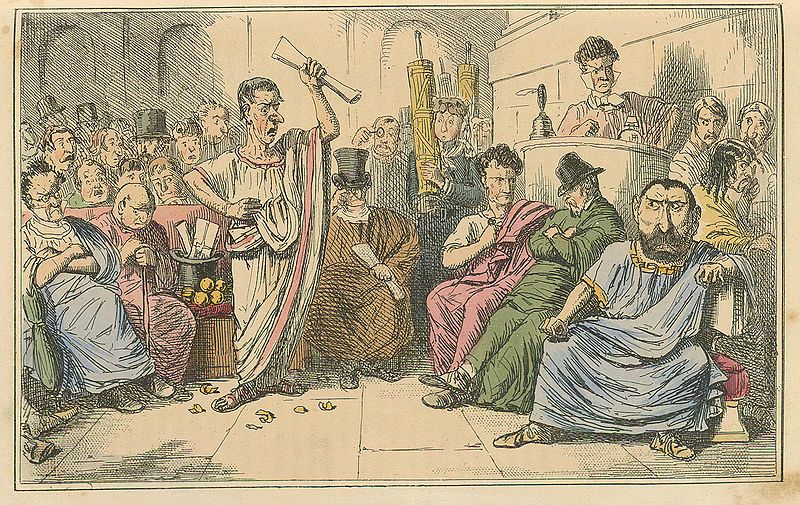
“Cicero denouncing Cataline,” The Comic History of Rome by Gilbert Abbott A Beckett, 1850s. What’s this? A creative piece, you say?
You’re spot on. This is a dialogue between Cicero and my supervisor at uni, Assoc. Prof. Parshia Lee-Stecum. I originally wrote it for Orpheus, the publication of MUCLASS (Melbourne University Classics and Archaeology Students Society). I was a little worried that my supervisor might not like it… Cicero does get a bit bitey with his replies! But thankfully it gave Parshia a chuckle and he said it was a good satire. In the end, I’m satisfied with the result.
As a senator of MUCLASS, I’m very proud of our first publication. The rest of Orpheus is full of amazing entries, including ancient recipes, Latin poetry, historical fiction, brilliant essays and much more. Do go and check it out on our new blog at muclass.wordpress.com – if you like anything classical or archaeological, I am sure you will enjoy it.
(CICERO knocks on the door to Assoc. Prof. Parshia Lee-Stecum’s office, which is half-open.)
PARSHIA: Oh, please come in, Marcus.
CICERO: (lingers in the doorway, somewhat affronted)
PARSHIA: Marcus? (glances at paper) Sorry, you’re Marcus Tullius Cicero, right?
CICERO: Well of course. I’m just astonished that anyone could be so barbaric as to call an unfamiliar by his praenomen.
Continue reading → -
When Classics students talk with Theology students

Theology students have it harder in other areas, but not in learning Greek. While I’m struggling through Plato and Herodotus, they’re generally translating shorter, more straightforward sentences. The nerve of them! Don’t they have to deal with bizarre verb forms, multiple dependent clauses, and the general uppitiness of the writers? Instead, they’re translating the stuff that sweaty-armpitted fishermen wrote so that other unwashed fisherman could understand. The New Testament was written in Koine so that it would be wonderfully accessible to anyone who would listen. But don’t take my word for it. Learn Attic, and it may drive you temporarily insane: Koine Greek is a cinch.
-
Real men wear moisturiser
Dear modern society,
Men should be allowed to rub skin cream into their skin. Deal with it.
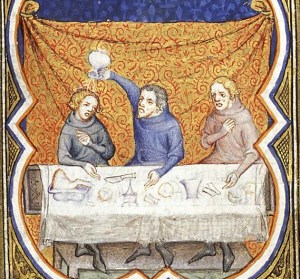
“Samuel anointing David”, Illustrator of Bible Historiale, 1372. (Source) The message I’m writing really should not need any historical precedent. For one thing, we accept that men and women both have teeth, and not only is it permissible for both men and women to brush their teeth, this is encouraged. What a daring new development! People in other societies might have looked down on our teeth care as a purely cosmetic preoccupation, but we know that teeth are important to our overall bodily health and that as responsible human beings we should take good care of them. Why isn’t the story the same with skin care? Both men and women have skin, and skin is a very important organ, regardless of gender. If it is damaged, it can become a site of infection. Worst of all, sun-damaged skin can become cancerous. A freckle-sized melanoma just one millimetre deep can become malignant, causing slow and horrifying deaths for thousands in cancer wards.
-
Another Latin word for kill
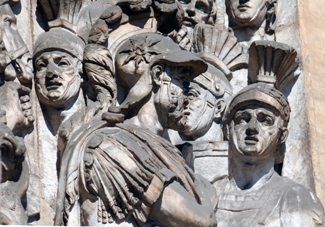
While I was translating some unseen Latin passages with my high school tutoring student, lo and behold, we came across another word for kill which I hadn’t yet collected! This word is:
cōnficiō, cōnficere, cōnfēcī, cōnfectum (con [with] + facere [make])
to make, effect, complete, accomplish;
to wear out, consume, destroy;
thus, to put an end to, kill.It has been duly added to the list of Latin words for kill.
Of course, one of the larger questions remains unanswered. Namely, why does Latin have so many words for kill? What drove people to say the word “kill” in so many, many ways?
-
Greek words for love, in context
A while ago, I tallied up the Latin words for kill. Today I’m doing something different: I’ll be studying the Greek words for love. Can I hear an “aww” from the audience? Or… was that a sigh of impatience?

Because to be honest, I’m tired of people talking about the Greek words for love. It’s a staple of church sermons, and I think in the course of time a lot of misconceptions have developed around the Greek words. Etymology (or often folk-etymology) is one of the oldest rhetorical devices for moving into a meditative discussion of the “real”, “true” or “original” concepts behind words. Talking about the concepts is good, but I’d like it if people made less fudgey mistakes about the language in the process. What I take issue with is the unwary and unthinking focus on the exact meanings of individual words outside of their context. And the endless talk of two Greek verbs for love, agapaō and phileō, is possibly the most meticulously bungled case of them all.
Because no matter what language you speak, love makes more sense in context than on a vocab list. Let’s explore.
-
Romans paint better perspective than Renaissance artists
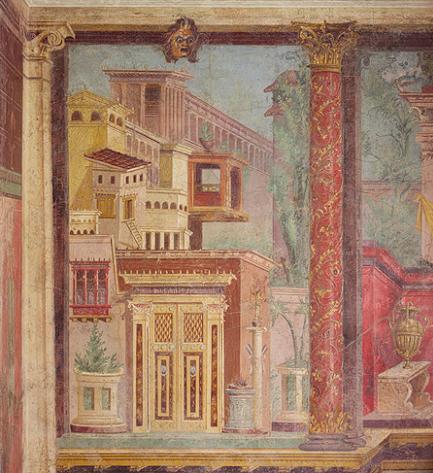
Fresco from the Villa of Publius Fannius Synistor, second-style wall painting, preserved by ash in 79 AD Visitors who see this fresco at the Met museum are often amazed at what seems to be a pre-Renaissance understanding of perspective. One visitor wrote that this “looks like an entire city–perspectivally rendered! The Middle Ages lost those lessons on perspective for sure.”
The statement picks up on a very common triumphalist attitude towards perspective. Perspective is a lesson to be learned by all good art students, it is the golden standard of realism, and the Renaissance Masters either discovered it or rescued it, after the utter ignorance of the Middle Ages.
But what do we mean by “perspective”? Did the Romans use linear perspective? And is the linear model really the best anyone could come up with?







 Found in Antiquity


